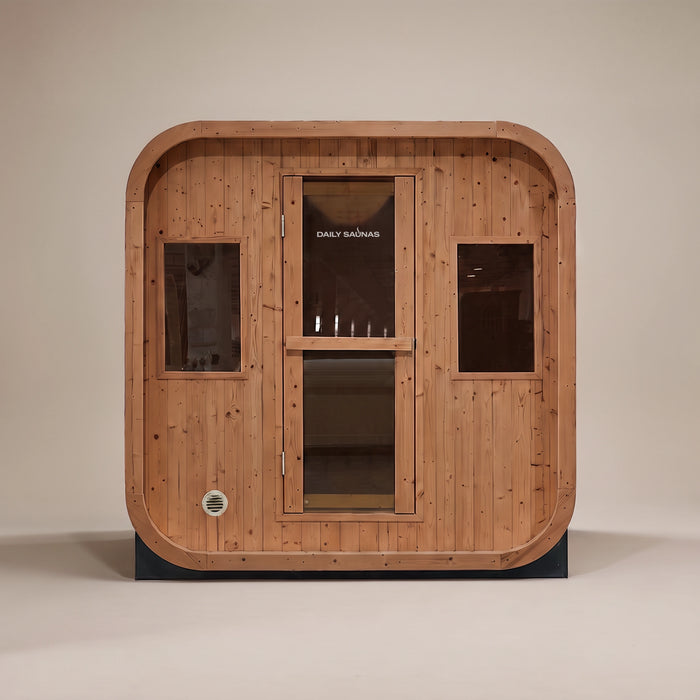

The infrared vs traditional sauna decision starts with a simple question: what do you want the heat to feel like? Before comparing wood, lights, or seating capacity, decide whether you prefer lower-temperature radiant warmth or a hotter cabin with a stone heater. That choice will help you build a useful shortlist.
The short answer
Infrared saunas use radiant heat to warm your body directly at lower air temperatures. Traditional saunas heat the cabin with a heater, often with stones that produce steam when water is added as directed. Choose based on your preferred heat, available space, electrical requirements, and interest in steam.
Infrared vs traditional sauna: a side-by-side comparison
The model figures below come from Daily Saunas specifications. They describe our lineup, not every sauna on the market. Maximum temperatures are product limits, not suggested settings for every user.
| What to compare | Infrared | Traditional |
|---|---|---|
| Heating method | Radiant heat directed toward the body | A heater warms the cabin air and stones |
| Typical experience | Lower air temperature and radiant warmth | Hotter surrounding air, with optional water-on-stone steam |
| Daily Saunas maximum | 149°F | 194°F |
| Listed warm-up | Under 20 minutes for the 1-Person Infrared Hemlock; 35–45 minutes for the outdoor infrared model | About 45 minutes for the outdoor traditional model |
| Power | 110V or 240V, depending on model | 240V |
| Electrician | No Electrician Required on the two 1-person models; Electrician Required on larger models | Electrician Required |
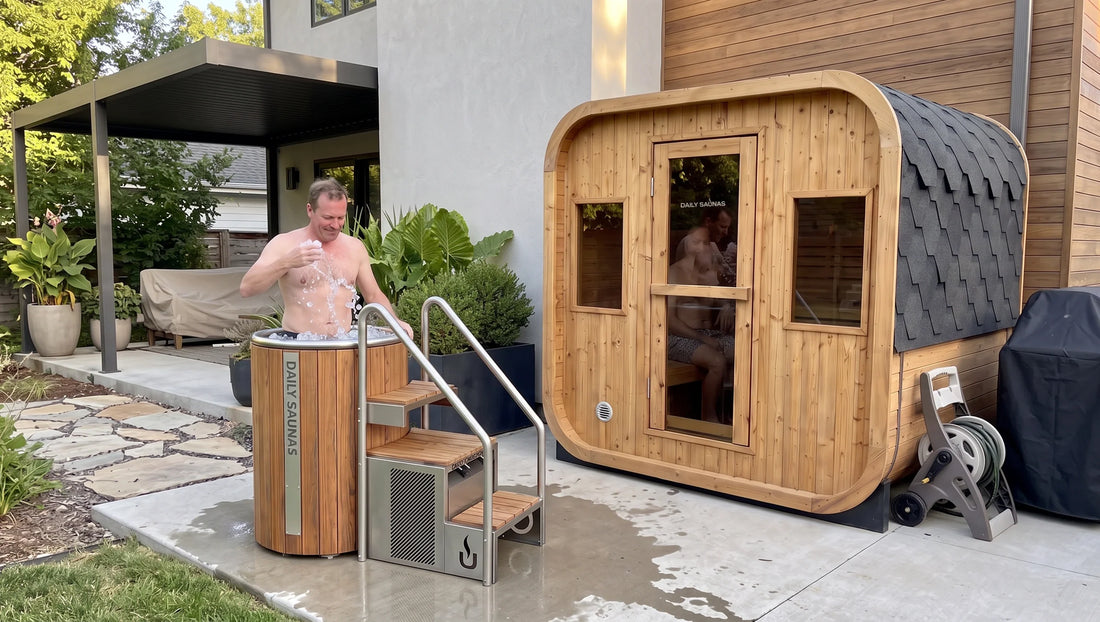
| Outdoor option | 4-Person Outdoor Infrared Cedar | 4-Person Outdoor Traditional Cedar |
| Best starting point | You prefer lower-temperature heat without a stone-heater routine | You want hotter cabin air and the option of steam |
Heating method: Mayo Clinic and Harvia.
How does each type of sauna heat you?


Infrared: warmth from the panels
An infrared sauna uses radiant energy to warm your body directly. It does not need the same high air temperature as a traditional sauna to deliver heat. Cleveland Clinic describes typical infrared temperatures of 110°F–135°F, compared with 150°F–195°F for traditional saunas. These are general ranges, not Daily Saunas model specifications. Cleveland Clinic.
If lower-temperature air is part of what attracts you, begin with the infrared sauna collection, then compare size and power. A higher number on the temperature display is not a reason to pick one model over another on its own.
Traditional: a heated cabin and stones
A traditional electric heater warms the air, the stones, and the cabin surfaces. Water poured on the hot stones produces steam, so you can adjust how the heat feels. Follow the heater instructions for how much water to use and where. Harvia.
If the stone-heater ritual is central to your plans, start with traditional saunas. Ask yourself whether you would still want the model without its decorative features. The answer helps separate a useful feature from a photo you simply like.
Which feels hotter, and can you add steam?
Traditional saunas generally have hotter air. Infrared offers a lower-temperature environment, which some people find more comfortable. That is a preference to explore, not a promise that either type will feel comfortable to everyone. Cleveland Clinic.
At Daily Saunas, the outdoor traditional model has a Harvia 6kW stone heater and steam. The infrared-only models heat with panels and have no stone heater. If steam is on your must-have list, look for a traditional or combination model; a full-spectrum or red-light label does not add steam.
Good to know. Steam only comes from water on hot stones. An infrared sauna has no stones, so every session stays dry.
If you can try a sauna before buying, pay attention to the whole experience. Do you enjoy sitting in hot surrounding air? Do you want control over steam? Would you rather keep your routine to setting a temperature and sitting near warm panels? Those answers are more useful than choosing the highest maximum temperature.
How long does a home sauna take to warm up?
Compare the actual models on your shortlist. Within Daily Saunas, the listed warm-up times vary considerably:
- 1-Person Infrared Hemlock: under 20 minutes.
- 1-Person Full Spectrum Hemlock: 15–25 minutes.
- 2-Person Infrared Hemlock: 25–30 minutes.
- 2-Person Combination Cedar: 30–40 minutes in either mode.
- 4-Person Outdoor Infrared Cedar: 35–45 minutes.
- 4-Person Outdoor Traditional Cedar: about 45 minutes.
That makes "infrared always warms up much faster" an unhelpful shortcut. The small indoor infrared model and the outdoor infrared model have different published times. Compare similar sizes and locations before deciding that one heating type fits your day better.
For planning, add the warm-up time to the time you intend to spend inside and drying the cabin afterward. Warm-up times are estimates: your target temperature, the room, and ventilation all change how long it takes. Harvia.
What do sauna studies actually tell us?
Research suggests sauna bathing may have health benefits, but the evidence does not establish a universally better choice between these two home-sauna types. A 2018 systematic review covered 40 studies, including only 13 randomized controlled trials. Most studies were small, and the authors called for more and better data on adverse effects and on how often and how long different people should use a sauna. Hussain and Cohen, 2018.
One frequently cited Finnish study followed middle-aged men and looked at links between sauna habits and later health outcomes. It was an observational study of 2,315 men in eastern Finland, not a comparison of home infrared and traditional cabins. Laukkanen et al., 2015.
For a buying decision, choose for the experience and the practical fit you can evaluate. Discuss individual health questions with your doctor rather than relying on any product description.
What power does a home sauna need?
Check the electrical requirements of the exact model. "Infrared" does not mean one voltage or one set of power requirements.
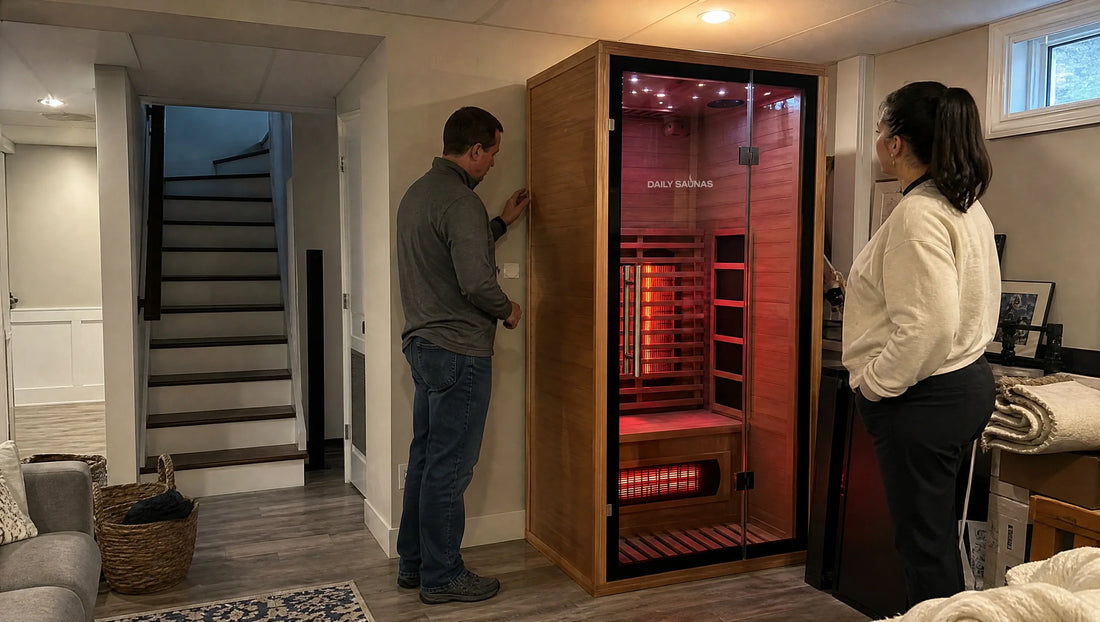
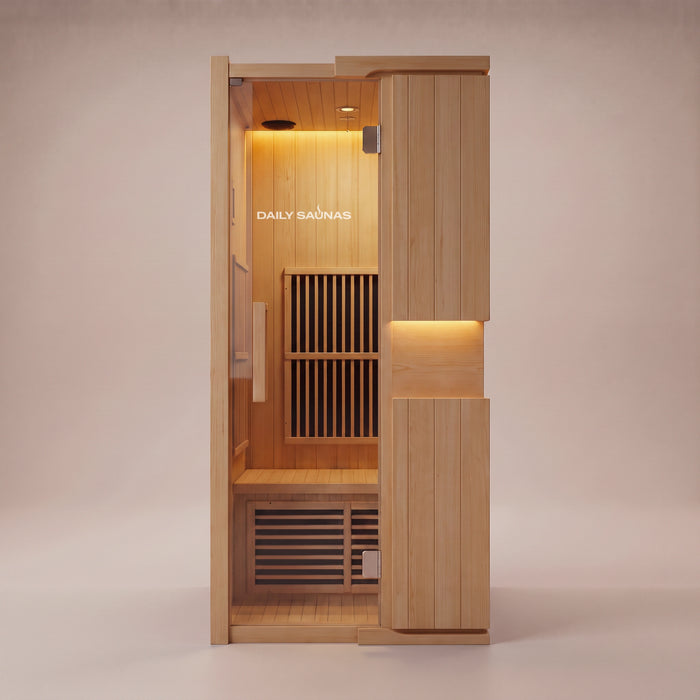
Both 1-person Hemlock models run on 110V and are No Electrician Required. If compact indoor use is your priority, the 1-Person Infrared Hemlock Sauna is a useful starting point.
The 2-Person Infrared Hemlock is also 110V, but it is Electrician Required, and so are the two 2-person red light and full spectrum models. Voltage alone does not tell you whether you need an electrician.
The combination model and both outdoor models run on 240V and are Electrician Required. Each product page lists the exact requirements, so check them against the spot you have in mind before you order.
Professional Assembly is a separate service
When you order a sauna, you can add Professional Assembly for $999 on its product page. The service covers assembling the sauna. It does not include electrical work, so plan the assembly and any electrician visit as two separate steps in your budget and schedule.
How much space do you need indoors or outdoors?
Start with width, depth, and height. Then leave room around the cabin for the door to open, for you to reach the controls, and for air to move.
| Daily Saunas model | Width × depth × height | Location |
|---|---|---|
| 1-Person Infrared Hemlock | 35.4″ × 35.4″ × 74.8″ | Indoor |
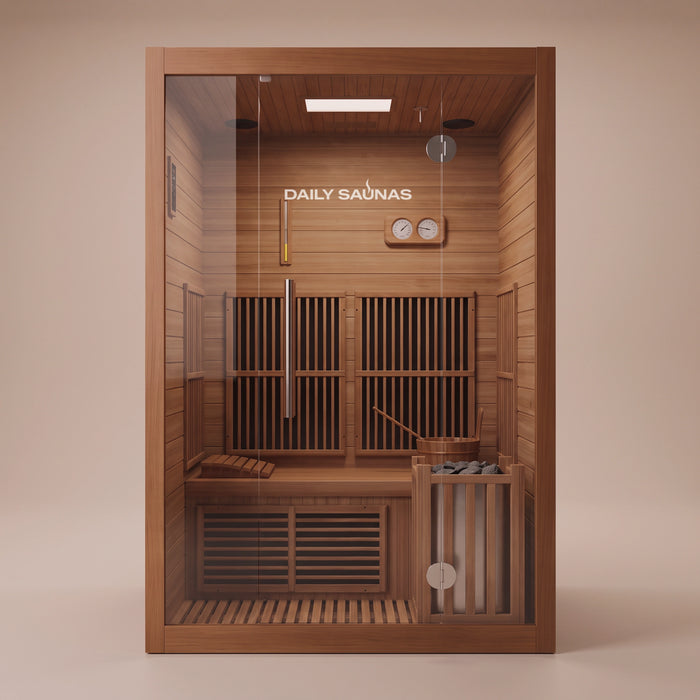
| 2-Person Combination Cedar | 53.1″ × 48.8″ × 78.7″ | Indoor |
| 4-Person Outdoor Traditional Cedar | 70.9″ × 70.9″ × 70.9″ | Outdoor |

Mark the footprint on the floor with tape. Walk around it and picture opening the door, bringing in towels, and reaching the controls. A person-count label tells you how many people fit, not how you like to sit, so picture your own routine too.
Plan the route from the delivery truck to the final spot as well. Check every doorway, turn, gate, and step along the way. Putting the sauna below ground? Our basement sauna guide covers ceiling height, moisture, and power.
Place each model where it is meant to go. Daily Saunas offers both outdoor infrared and outdoor traditional models, so going outside does not decide the heating type for you. Indoor models belong indoors, not on a porch or in the yard.
How much electricity does a sauna use per session?
Estimate the electricity cost with this formula:
Power in kW × hours switched on × your price per kWh
The latest EIA data, for July 2026, shows a US residential average of 18.31¢ per kWh, or $0.1831. Rates vary by state and utility, so use your own bill for a personal estimate. EIA, Table 5.6.A.
The examples below assume one hour switched on, including warm-up. They are simple arithmetic, not measured use, and not a suggestion to stay inside for an hour.
| Daily Saunas model | Listed power | Calculation | Cost per hour |
|---|---|---|---|
| 1-Person Infrared Hemlock | 1.4kW | 1.4 × 1 × $0.1831 | Up to about $0.26 |
| 4-Person Outdoor Infrared Cedar | 2.7kW | 2.7 × 1 × $0.1831 | Up to about $0.49 |
| 4-Person Outdoor Traditional Cedar | 6.0kW heater | 6.0 × 1 × $0.1831 | Up to about $1.10 |
These are "up to" figures. Once the cabin reaches the set temperature, the thermostat switches the heating elements on and off, so they do not draw full power the whole time. Harvia.
These figures leave out fixed utility charges. For the full picture, weigh energy use alongside the purchase price, assembly, and any electrical work your model needs.
Which sauna should you choose?
Choose infrared if lower-temperature heat is your priority
Start here if you want radiant warmth and do not need steam. For a small indoor space, the 1-Person Infrared Hemlock is $4,999, with a 149°F maximum and a listed warm-up of under 20 minutes.
If two people will use the cabin together, compare the 2-Person Infrared Hemlock at $5,999. It is larger and it is Electrician Required, so check the space and the power before you decide.
Choose traditional if hot air and stones are essential
Start here if you want a stone heater and water-on-stone steam. The 4-Person Outdoor Traditional Cedar is $6,999, with a 194°F maximum and a warm-up of about 45 minutes. Compare it with the outdoor infrared model on our 4-person outdoor saunas page.
Check its outdoor spot, footprint, and Electrician Required status together. A model can match your preferred heat and still not fit your space, so decide where it will go first.
Choose a combination if your household wants both
The 2-Person Combination Cedar Sauna pairs infrared heating with a Harvia stone heater, so you can switch between infrared warmth and traditional stone heat. It costs $8,499, with maximums of 149°F in infrared mode and 194°F in traditional mode.
It makes sense when one person prefers infrared and another wants traditional heat, or when you want both experiences in one cabin. It is an indoor model and Electrician Required. Choose it because both heating options matter to you, not simply because more features sound better. Our hybrid sauna guide compares its two modes in detail, and you will find it on our hybrid saunas page.
What about cedar, hemlock, and maintenance?
Settle the heating type before treating wood as the deciding factor. Daily Saunas offers the 2-Person Red Light + Full Spectrum Hemlock at $6,999 and the Cedar version at $7,499. They share the same dimensions, maximum temperature, warm-up range, and power, so the wood is the main difference. Both are on our 2-person red light saunas page.
For care, follow your cabin's own instructions. Harvia's general guidance: protect the benches with a towel, wipe surfaces with a damp cloth, and let the sauna dry out after use. Use cleaning products or treatments only if your cabin's instructions allow them. Harvia.
How should you approach your first session?
Read the operating manual before switching the sauna on. Learn the controls, then start gently rather than aiming for the maximum temperature.
Talk to your doctor if you are pregnant or have a heart condition. Cleveland Clinic advises drinking water before and after, skipping the sauna after alcohol, and starting with about five minutes, adding time from session to session. Leave right away if you feel dizzy, weak, or short of breath, and get medical help if you need it. Cleveland Clinic.
Frequently asked questions
Is infrared better than traditional sauna?
Neither is the best fit for every household. Infrared offers lower-temperature radiant heat; traditional suits people who prefer hotter air and steam from the stones. Compare the actual model's space, power, and features rather than expecting the heating type to settle every question.
Can an infrared sauna make steam?
No. Our infrared-only models have no stone heater, so sessions stay dry. Choose a traditional or combination model if steam matters to you, and never pour water on infrared panels.
Is full spectrum the same as a combination sauna?
No. Full spectrum is a type of infrared heating. The 2-Person Combination Cedar adds a traditional Harvia stone heater to infrared panels. A red light feature does not add traditional heat either.
Do all infrared saunas need an electrician?
No. Our two 1-person models are No Electrician Required and plug into a standard household outlet. Our 2-person and larger models are Electrician Required. Check the exact product page rather than relying on the word "infrared."
Can an infrared sauna go outside?
Only a model built for outdoor use. Daily Saunas offers the 4-Person Outdoor Infrared Cedar for the backyard. Our indoor infrared models belong indoors.
Which type costs less to run?
At the same electricity rate and time switched on, a lower power rating costs less. In our examples the infrared models come out lower, but your total depends on the model, warm-up, session length, and your local rate.
Find the sauna that fits your home
Write down your preferred heat, location, seating needs, and electrical requirements before comparing extras. Then check the dimensions and warm-up time against the space and schedule you actually have.
Still deciding? Take the 1-Minute Quiz and keep your measurements nearby so you can compare the suggested models with your space.
Sources
- Do infrared saunas have any health benefits? Mayo Clinic, 2024. mayoclinic.org
- Infrared Saunas: What They Do and 6 Health Benefits. Cleveland Clinic, 2022. clevelandclinic.org
- Get Your Sweat On: The Benefits of a Sauna. Cleveland Clinic, 2024. clevelandclinic.org
- Hussain J, Cohen M. Clinical Effects of Regular Dry Sauna Bathing: A Systematic Review. Evidence-Based Complementary and Alternative Medicine, 2018. PubMed
- Laukkanen T, Khan H, Zaccardi F, Laukkanen JA. Association Between Sauna Bathing and Fatal Cardiovascular and All-Cause Mortality Events. JAMA Internal Medicine, 2015. PubMed
- Electric Power Monthly, Table 5.6.A, July 2026 data. US Energy Information Administration, released September 24, 2026. eia.gov
- FAQ about the energy consumption of sauna bathing. Harvia. harvia.com
- Harvia Sauna Heater Stones. Harvia. harvia.com
- Maintaining your sauna. Harvia Support, 2026. harvia.com
- Daily Saunas product specifications, September 2026.