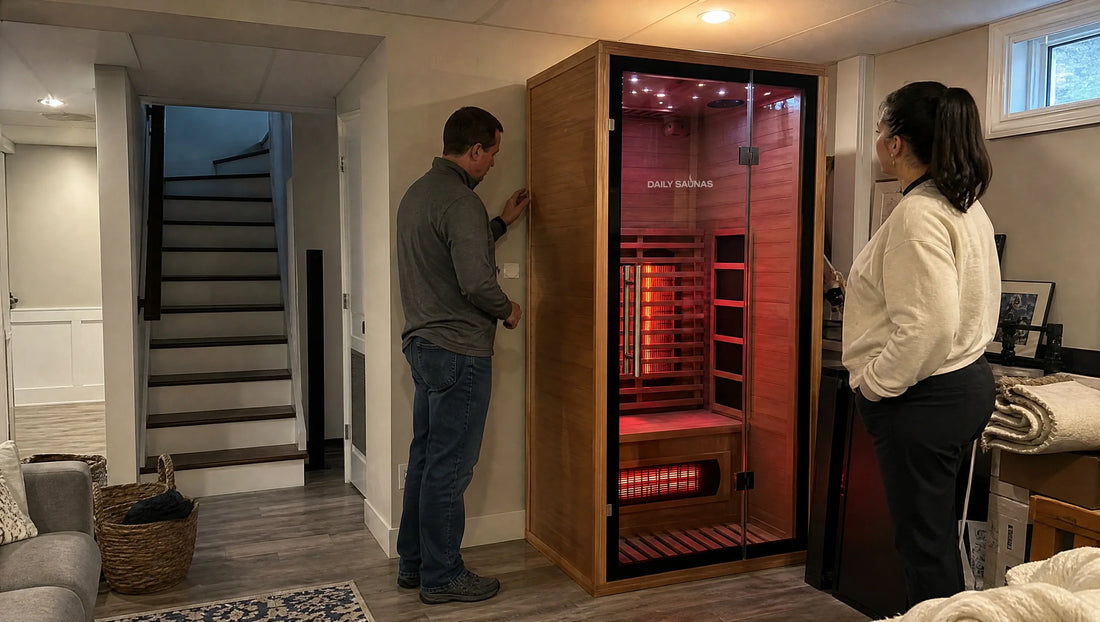

How often should you use a sauna when you are just starting? It helps to separate two decisions: how long to stay inside, and where sauna time fits into your week. Begin with a short, comfortable session rather than a daily streak, and let the habit fit your calendar instead of becoming another obligation.
The short answer
There is no proven sauna schedule that suits everyone. Cleveland Clinic suggests beginners start with about five minutes, and its infrared guidance recommends limiting visits to three or four times a week. Treat those numbers as a starting point and an upper limit, then build a routine around your health, comfort, and free time.
How often should you use a sauna as a beginner?
Start by finding a place for the sauna in the week you already have. Pick times when you can get ready, use the cabin, and finish without rushing, and leave the other days open.
Research does not point to one ideal beginner frequency. A 2018 systematic review named frequency and session length as areas that still need study. Hussain and Cohen, 2018.
A simple first week
The table below is an example infrared calendar, not a tested plan. Three sessions stay within Cleveland Clinic's infrared limit of three or four visits a week, and five minutes follows its beginner advice. The days themselves are just an example. Cleveland Clinic, infrared; Cleveland Clinic, beginners.
| Day | Time inside | Plan |
|---|---|---|
| Monday | About 5 minutes | First session. Leave sooner if you want to. |
| Tuesday | — | No session. |
| Wednesday | About 5 minutes | Repeat the same short session. |
| Thursday | — | No session. |
| Friday | About 5 minutes | Third session, if it fits your week. |
| Saturday | — | Open day. |
| Sunday | — | Look back at which days worked best. |
Skipping a planned day is fine. The empty days are there to keep the week easy, not as a required recovery period. For a traditional sauna, use the session-length guidance below rather than the infrared frequency limit.
How long should you stay in a sauna?
Traditional sauna: start with a short visit
UCLA Health recommends that new sauna bathers start with five to 10 minutes, build up gradually, and keep sessions to 20 minutes at most. Harvard Health advises staying in no more than 15–20 minutes. These are upper limits, not targets to reach. UCLA Health; Harvard Health.
Infrared sauna: lower heat, still a time limit
Cleveland Clinic suggests starting an infrared session at about 110°F for five to 10 minutes and keeping sessions below 30 minutes, even for experienced users. Cleveland Clinic.
An infrared sauna warms your body directly at a lower air temperature than a traditional one. That changes how the heat feels, not how long you should stay. Mayo Clinic. Our infrared vs traditional sauna guide explains the two experiences in more detail.
Add time gradually
UCLA Health supports building up slowly but does not set a fixed number of extra minutes per visit. Keep it simple: stay with a short session until it feels easy, then add a little time. If a doctor has given you personal guidance, follow that first. UCLA Health.
A short note after each session helps: heating mode, temperature setting, minutes inside, and how you felt.
Good to know. Warm-up time and session time are different things. Warm-up is how long the cabin takes to heat; session time is how long you stay inside.
Can you use a sauna every day?
Daily use shows up in sauna research, but that does not make it the right starting point. A Finnish study grouped men by how often they already used a sauna: once a week, two to three times a week, and four to seven times a week. These were habits people reported, not schedules given to beginners. Laukkanen et al., 2015.
For infrared saunas, Cleveland Clinic recommends three or four visits a week rather than daily use. Cleveland Clinic.
The better question is whether a schedule works for you. A home sauna makes access easy, but it does not have to set your pace. Keep the calendar flexible so a skipped day feels normal.
What does the research say about frequency?
The Finnish study followed 2,315 middle-aged men. It found an association between how often they used a sauna and later health outcomes. It did not prove that more sauna visits caused those outcomes, and it did not compare beginner plans. Laukkanen et al., 2015.
A 2018 review covered 40 studies, including 13 randomized controlled trials. Most were small, and the authors called for more and better data, including on side effects and on how often and how long different people should use a sauna. Hussain and Cohen, 2018.
A schedule in a study describes what researchers observed. It is useful context, not a plan for your calendar.
What should you do before and after a session?
Before
UCLA Health advises drinking water before, during, and after sauna use, and avoiding alcohol before or during it. UCLA Health.
Have a towel and water ready and choose your heating mode before you start. If you share the sauna, agree on who goes when, so nobody waits in front of a warm cabin.
After
Harvard Health recommends cooling down gradually and drinking water after each session. Harvard Health.
Count this time as part of the routine. A session that ends right before your next commitment leaves no room to cool down.
When should you skip a session or talk to your doctor?
Talk to your doctor if you are pregnant or have a heart condition. Cleveland Clinic also advises checking with a doctor first if you take medication, are older than 65 or younger than 16, have certain neurological conditions such as epilepsy, or have had a recent heart attack or stroke. Cleveland Clinic.
Skip the sauna when you are ill or have been drinking alcohol, and leave if you start to feel unwell. Harvard Health.
If you feel dizzy, weak, or short of breath, get out and seek medical help. How you feel always matters more than the timer. Cleveland Clinic.
Is morning, evening, or after a workout better?
Pick a time you can keep without rushing. There is no single best hour; it is a scheduling choice.
Morning works if the house is quiet and your first commitment leaves room for the whole routine. Evening may be easier if mornings are already full. Count every step: warm-up, time inside, and cooling down.
After a workout, keep your usual cool-down first. Harvard Health recommends five to 10 minutes of slower movement after exercise. Harvard Health. UCLA Health notes that sauna use after exercise has been studied. UCLA Health.
To make it a habit, link the sauna to something you already do, like finishing work or putting away your gym bag, and still check in with how you feel before each session.
How can a home sauna fit your week?
A home sauna removes the drive to a gym or spa. Plan for warm-up time separately from time inside, and choose a model that fits your space and routine rather than an ambitious daily goal. If you plan to pair heat with cold water, our sauna and cold plunge guide covers safe temperatures and timing.


For a solo indoor routine
The 1-Person Infrared Hemlock Sauna warms up in under 20 minutes, reaches up to 149°F, and is No Electrician Required. It costs $4,999.
The 1-Person Full Spectrum Hemlock Sauna warms up in 15–25 minutes, reaches up to 149°F, and is No Electrician Required. It costs $5,299.
Both are indoor models; see them side by side on our 1-person infrared saunas page. The maximum temperature is what the sauna can do, not a suggested starting setting.
For two people with different preferences
The 2-Person Combination Cedar Sauna lets you switch between infrared and traditional heat. It warms up in 30–40 minutes, reaches up to 149°F in infrared mode and 194°F in traditional mode, and is Electrician Required. It costs $8,499.
Each person can use the mode and session length that suits them, together or at different times. Our hybrid sauna guide compares the two modes.
Frequently asked questions
Is five minutes enough for a beginner?
About five minutes is the starting point Cleveland Clinic suggests for beginners. You can add time gradually as it starts to feel easy, staying within the upper limits above.
Is 30 minutes too long in an infrared sauna?
Cleveland Clinic advises keeping infrared sessions below 30 minutes, even for experienced users. Beginners should start much shorter, at about five to 10 minutes.
Does warm-up count as session time?
No. Warm-up is the time the cabin takes to heat. Session time is the time you spend inside. Plan for both, but only count the time inside.
Can I use a sauna after exercise?
Sauna use after exercise has been studied. Do your usual cool-down first, drink water, and follow the same session-length and health guidance as any other day.
Is morning or evening better?
There is no best hour. Choose the time that fits your day, including warm-up and cooling down. If a time keeps feeling rushed, move it.
What if I miss a planned session?
Just carry on with your week. There is nothing to make up. If you often miss the same day, choose a different one.
Build a routine you can keep
Start with a simple calendar, a short first session, and enough time to get ready and cool down. Keep notes that help you learn what works, and adjust as you go.
Still choosing a sauna? Take the 1-Minute Quiz to find a model that fits your space and the heat you prefer.
Sources
- Get Your Sweat On: The Benefits of a Sauna. Cleveland Clinic, 2024. clevelandclinic.org
- Infrared Saunas: What They Do and 6 Health Benefits. Cleveland Clinic, 2022. clevelandclinic.org
- Hussain J, Cohen M. Clinical Effects of Regular Dry Sauna Bathing: A Systematic Review. Evidence-Based Complementary and Alternative Medicine, 2018. PubMed
- Laukkanen T, Khan H, Zaccardi F, Laukkanen JA. Association Between Sauna Bathing and Fatal Cardiovascular and All-Cause Mortality Events. JAMA Internal Medicine, 2015. PubMed
- Do infrared saunas have any health benefits? Mayo Clinic, 2024. mayoclinic.org
- Benefits of sauna bathing for heart health. UCLA Health, 2023. uclahealth.org
- Sauna Health Benefits: Are saunas healthy or harmful? Harvard Health Publishing, 2020. health.harvard.edu
- Exercise 101: Don't skip the warm-up or cool-down. Harvard Health Publishing, 2020. health.harvard.edu
- Daily Saunas product specifications, September 2026.